

Vector Embedding
What is a Vector?
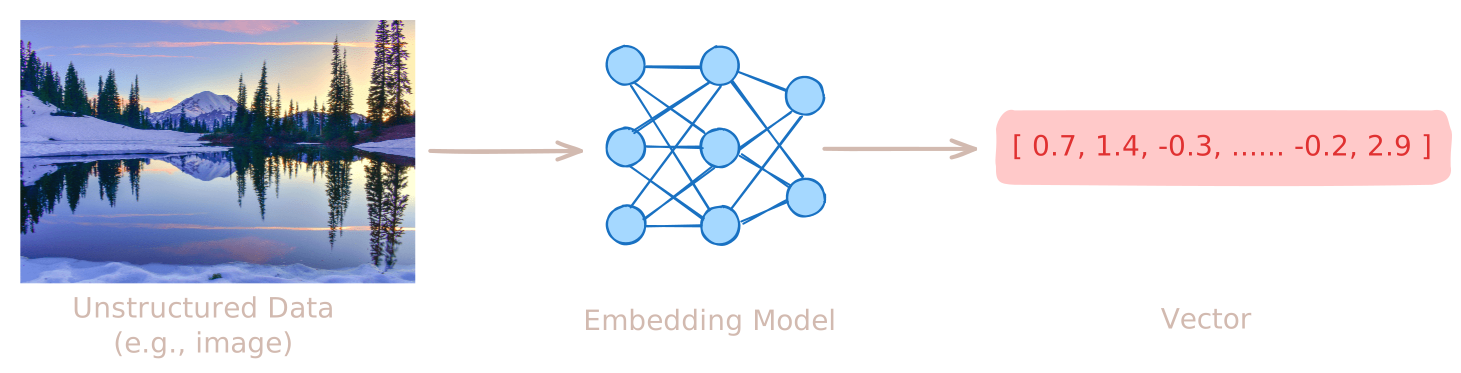
In the context of AI and vector databases, a vector is a list of numbers generated by embedding models to capture the semantic essence of unstructured data — such as text, images, or audio.
These models transform raw input into a high-dimensional space where semantically similar items produce similar vectors, enabling AI systems to compare meaning rather than relying on exact word matches.
How Do You Use Vectors with a Database?
- 🗂️ Store: Generate embeddings from your data — documents, product images, or user profiles — and save them in the vector database.
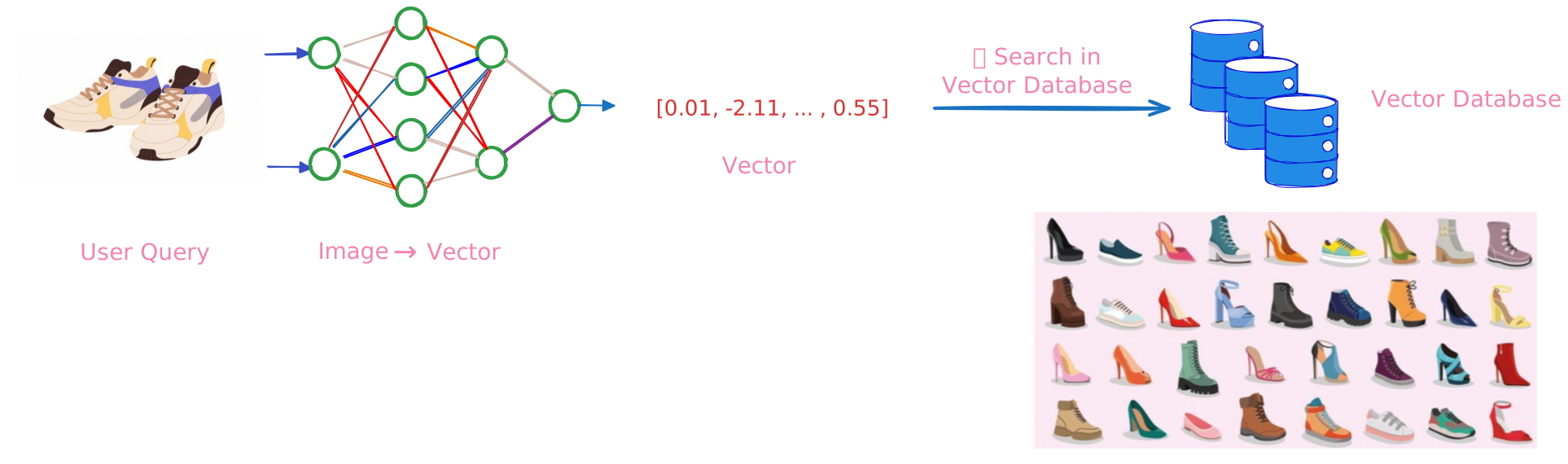
- 🔍 Search: When a new query arrives (a question, photo, etc.), generate a query vector using the same embedding model, then ask the database to find the most similar stored vectors.
Using efficient indexes, the database quickly returns relevant results — even at large scale. This is the foundation of semantic search: finding what means the same, not just what says the same.
How Vectors Power Real-World Applications?
Image search is a great example:
- Each image is converted into a vector that captures its visual features — such as shape, color, and object type.
- Images that are visually or semantically similar end up with nearby vectors.
By comparing these vectors, systems can:
- ✅ Recognize the same person across different photos: Even with changes in lighting, pose, or expression, images of one individual generate similar vectors, allowing the system to match identities reliably.
- ✅ Find look-alike products in e-commerce: When a user snaps a photo of a dress, lamp, or sofa, the system compares its vector to product vectors and retrieves items with similar appearance or style.
All of this happens through fast vector similarity comparisons, powered by the vector database.
What is an Embedding Model?
An embedding model is an AI model that converts raw data into vector embeddings — illustrated in the diagram at the top.
These models learn patterns from vast amounts of training data so that objects with similar meanings produce vectors that are close together in vector space — typically measured using distance metrics such as cosine similarity, dot product, or Euclidean distance.
The choice of distance metric matters. If an embedding model was trained for a specific metric (e.g., cosine similarity), the vector database should use the same metric during search to preserve semantic relationships and achieve optimal accuracy.
To explore and compare state-of-the-art embedding models, you can check out the Embedding Leaderboard on Hugging Face, which evaluates hundreds of models across diverse tasks and languages.
Types of Vectors
Vector representations are primarily categorized into two types: dense and sparse, each capturing data in its own way.
Dense Vectors
Dense vectors are fixed-length, real-valued embeddings where (nearly) every dimension carries semantic information. These vectors are often generated by deep learning models that transform raw inputs (e.g., text, images, audio) into a structured vector space reflecting their semantic similarities.
# Example: 384-dimensional dense vector from a neural network model
dense_vector = [ 0.012, -0.034, 0.005, 0.041, -0.022, ..., 0.018 ] # Length = 384- ✅ Semantic-Rich: understands context and meaning (e.g., "king – man + woman ≈ queen")
- ⚠️ Opaque: hard to interpret which features drive similarity
Sparse Vectors
Sparse vectors are high-dimensional, often vocabulary-sized representations in which only a small subset of dimensions are non-zero. Each active dimension corresponds to a specific term (e.g., a word or n-gram), weighted by relevance scores such as BM25.
In this model, every document is converted into a vector — called a document vector — that records which terms appear in it and how important they are. Similarly, a search query is also turned into a sparse vector using the same weighting scheme.
Rather than relying on exact keyword matches, similarity between a query and a document is computed using the dot product of their vectors. This measures how well their weighted terms align: documents that contain the same important terms as the query receive higher scores — rewarding both term overlap and term importance.
# Example: Sparse vector over a vocabulary of 50,000 terms, stored as {term: weight}
sparse_vector = {
    "puppy": 2.31,
    "dog": 1.85,
    "pet": 1.12,
    "animal": 0.76
}
# The remaining ~49,996 dimensions are implicitly zero.
For computational efficiency, sparse vectors use integer indices to map terms to their positions within a vocabulary dictionary rather than storing the term strings directly.
# Vocabulary mapping, containing around 50,000 unique terms, indexed by integer IDs
vocab = {
    "animal": 124,
    "dog": 309,
    "pet": 1822,
    "puppy": 4017,
    "cat": 5001,
    "kitten": 7890,
    # ... (many other terms fill the rest of the dictionary)
    # Total size ≈ 50,000
}

# Sparse vector stored as {index: weight}
sparse_vector = {
    4017: 2.31,   # "puppy"
    309: 1.85,    # "dog"
    1822: 1.12,   # "pet"
    124: 0.76     # "animal"
}
# The remaining ~49,996 dimensions are implicitly zero.- ✅ Interpretable: non-zero dimensions map directly to known terms (e.g.,
4017→ "puppy") - ⚠️ Lacks Semantic Understanding: treats "car" and "automobile" as unrelated unless explicitly linked